eSIM vs Corporate Roaming Contracts: Which Makes More Sense for Business Travel?
For businesses with employees travelling internationally, mobile connectivity is no longer a “nice to have”. It’s essential for productivity, security, and cost control.
Traditionally, most organisations have relied on corporate roaming contracts as the default solution. But in 2026, more companies are switching to business eSIM plans because they’re easier to deploy, easier to manage, and far more predictable from a cost perspective.
So which option is best for your organisation? In this guide, we’ll compare corporate roaming contracts and eSIM side-by-side, and explain when each approach makes the most sense.
What is a Corporate Roaming Contract?
A corporate roaming contract is typically an add-on agreement with your existing mobile provider. It allows employees to use their SIM abroad, usually with pre-set daily fees, regional bundles, or “roam like home” style allowances.
It’s often chosen because it feels simple: staff keep their current SIM, and the business stays with one supplier.
However, corporate roaming contracts can come with limitations that only become obvious when travel increases or expands into new regions.
What is a Business eSIM?
An eSIM is a digital SIM that can be installed on compatible devices without needing a physical SIM card. Instead of swapping plastic SIMs, employees scan a QR code or install a plan in seconds.
For business travel, eSIM is commonly used as a dedicated mobile data plan that activates as soon as the employee arrives in-country.
That means no waiting, no hunting for local SIM cards, and no reliance on unpredictable roaming rates.
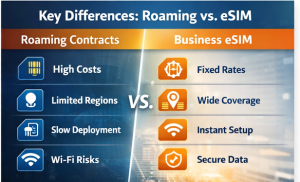
eSIM vs Roaming: The Key Differences
1) Cost predictability
Roaming contracts: Often include daily fees, fair usage policies, or hidden limits that can lead to unexpected charges. Even “inclusive” plans may have exclusions for certain countries or networks.
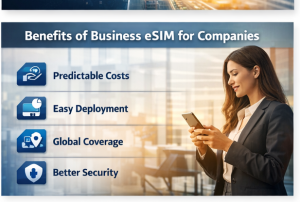
Business eSIM: Typically prepaid, meaning you know the cost upfront. This makes it far easier for finance teams to forecast travel connectivity spend and avoid bill shock.
Best choice for predictable costs: eSIM
2) Coverage across regions
Roaming contracts: Coverage can be inconsistent depending on where staff travel. Some destinations are classed as premium zones, while others may not be included at all.
Business eSIM: You can choose destination-specific plans, regional plans, or multi-country plans based on where your teams actually travel. This is especially useful for companies operating across multiple regions.
Best choice for flexible coverage: eSIM
3) Setup and deployment
Roaming contracts: Can involve account changes, contract terms, and provisioning delays. Rolling it out to a larger team can become an administrative task.
Business eSIM: Deployment is fast. Plans can be issued to employees digitally, even at short notice. This works well for urgent travel, last-minute trips, and short-term projects.
Best choice for rapid rollout: eSIM
4) Employee experience
Roaming contracts: Staff may need to enable data roaming, troubleshoot connection issues, or deal with slow speeds if their plan is restricted.
Business eSIM: Employees can land with data already installed and ready to go. This reduces stress and makes international travel smoother, particularly for senior staff who need reliable connectivity immediately.
Best choice for traveller experience: eSIM
5) Security and compliance
Roaming contracts: When roaming is expensive or unreliable, employees often switch to public Wi-Fi or personal SIM cards. That can create security risks and reduce visibility for IT teams.
Business eSIM: Providing prepaid mobile data reduces reliance on public Wi-Fi and helps organisations maintain better control over how staff connect while travelling.
Best choice for reducing Wi-Fi reliance: eSIM
6) Scaling to global teams
Roaming contracts: Often designed around one home country and one provider. This can become awkward when businesses have staff in multiple regions or travel frequently across multiple zones.
Business eSIM: Works well as a scalable layer for global mobility. It can support travelling employees, remote staff, and distributed teams without changing domestic contracts.
Best choice for global scalability: eSIM

When a Corporate Roaming Contract Makes Sense
- Your travel is limited to a small set of countries where your provider has strong roaming agreements
- You need voice and SMS roaming included as part of one corporate plan
- Your organisation prefers a single telecom contract and minimal change management
When Business eSIM Makes Sense
- You want predictable, prepaid data costs with fewer bill surprises
- Your staff travel across multiple regions or to “premium zone” destinations
- You need fast, scalable deployment for teams, contractors, or urgent trips
- You want to reduce reliance on public Wi-Fi and improve traveller productivity
Bottom Line
For many organisations, the best approach is not either/or.
Corporate roaming contracts can work for predictable travel patterns. But business eSIM is often the better solution for modern mobility: it’s quicker to deploy, easier to control, and far more transparent in cost.
If your teams travel internationally, support contractors abroad, or operate across regions, business eSIM can remove friction while improving oversight and employee experience.
Talk to Planet eSIM
Planet eSIM provides enterprise-grade eSIM connectivity for business travel, remote teams, and international contractors.
If you want predictable pricing, flexible coverage, and fast deployment, contact our team to discuss the right setup for your organisation.
Recent 'News' articles

Planet eSIM Expands Again with Mayotte, Martinique and Saint Barthélemy
Planet eSIM Expands Again with Mayotte, Martinique and Saint Barthélemy Planet eSIM continues to grow, and we are pleased to announce three more destinations now available to customers worldwide. You can now enjoy fast and reliable mobile data in Mayotte, Martinique and Saint Barthélemy, helping travellers stay connected in even more sought-after locations. New Destination: […]

Planet eSIM Adds Two New Destinations: San Marino and Saint Martin
We are pleased to announce two new destinations now available on Planet eSIM. Travellers and business users can now enjoy fast, reliable mobile data in San Marino and Saint Martin, making it even easier to stay connected while abroad. New Destination: San Marino eSIM One of Europe’s smallest and most historic countries, San Marino is […]

How to Cut International Mobile Costs for Remote Teams in 2026
Managing mobile data for international teams has become harder, not easier. Remote staff, contractors, sales teams, engineers, consultants and executives all need reliable connectivity when they travel. But without a clear system in place, costs can quickly become unpredictable. For many businesses, the problem is not just the price of roaming. It is the lack […]