Public Wi-Fi Risks for Business Travellers (and Why Mobile Data is the Safer Option)
When employees travel for work, staying connected is essential. They need access to email, messaging, cloud files, video calls, booking platforms, and business systems on the move.
But when roaming is expensive or unreliable, many travellers fall back on the quickest option available: public Wi-Fi.
Airport lounges, hotels, cafés, coworking spaces, conference venues, and even taxis now offer free Wi-Fi. It feels convenient, but for businesses, it can quietly introduce serious security risks.
In this article, we’ll explain why public Wi-Fi is risky for business travel, what the real-world threats look like, and why providing secure mobile data through eSIM is often the smarter alternative.
Why Public Wi-Fi is a Business Risk
Public Wi-Fi networks are shared environments. You don’t control who else is connected, how the network is configured, or whether the access point is legitimate.
Even when a network looks official, there are still risks around how traffic is handled, whether it’s encrypted, and what a malicious actor on the same network can potentially do.
For organisations handling sensitive information, this matters because a single compromised device can lead to:
- Loss of confidential business data
- Account takeover and credential theft
- Unauthorised access to cloud systems
- Compliance issues and reputational damage
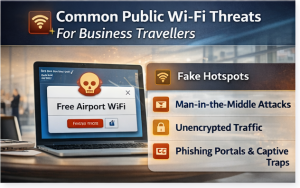
Common Public Wi-Fi Threats Business Travellers Face
1) Fake Wi-Fi networks (Evil Twin hotspots)
One of the most common risks is a fake Wi-Fi hotspot that mimics a real one.
For example, an attacker might create a network called:
- “Airport_Free_WiFi”
- “Hotel Guest Wi-Fi”
- “Conference_WiFi_2026”
A traveller connects without thinking, and the attacker can potentially monitor traffic or redirect the user to fake login pages designed to steal passwords.
2) Man-in-the-middle attacks
On unsecured or poorly configured networks, attackers may attempt to intercept traffic between a device and the websites or services it’s accessing.
Even when sites use HTTPS, some attacks focus on:
- Session hijacking
- Downgrading connections
- Capturing credentials through phishing portals
3) Unencrypted traffic and weak security settings
Some public Wi-Fi networks still use outdated security, or no encryption at all. Others use shared passwords that are widely known.
This makes it easier for attackers on the same network to observe traffic or target devices that have sharing settings enabled.
4) Device exposure through open sharing
Laptops and phones can be vulnerable when features like file sharing, AirDrop, printer discovery, or network discovery are left on.
In a shared public network, this can expose devices to unwanted connection attempts or scanning activity.
5) Phishing and captive portal traps
Many public networks use captive portals, where you must accept terms or enter an email address to get online.
Attackers can copy these portals and use them to:
- Collect login details
- Deliver malware links
- Capture business email addresses for targeted attacks
Why This Risk Increases During Business Travel
Even well-trained employees can make mistakes when travelling. People are more likely to connect to public Wi-Fi when they are:
- Rushing to join a call
- Trying to send a file urgently
- Landing in a new country with no data connection
- Dealing with roaming restrictions or slow speeds
- Working late and not thinking about security
In other words, travel creates the perfect conditions for risky decisions, even for senior staff.
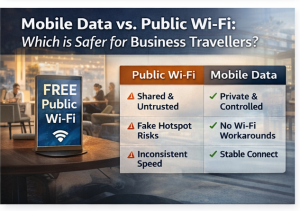
Mobile Data vs Public Wi-Fi: Why Mobile Data is Usually Safer
Mobile data isn’t invincible, but it typically offers a safer and more controlled connection than public Wi-Fi.
Key advantages include:
- No shared local network with unknown devices nearby
- Less exposure to fake hotspots and captive portal attacks
- More consistent connectivity for business-critical apps
- Fewer employee workarounds when data is available immediately
For businesses, the goal is not just security, it’s reliability and productivity as well.
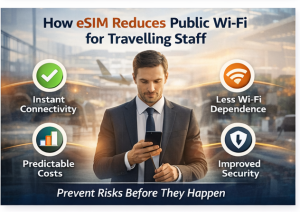
How eSIM Helps Businesses Reduce Public Wi-Fi Use
For international travel, one of the main reasons employees use public Wi-Fi is simple: they don’t have data when they need it.
With a business eSIM, organisations can provide prepaid mobile data that is ready as soon as the traveller arrives. That means:
- Employees can connect immediately without searching for Wi-Fi
- Travel teams can plan connectivity before departure
- Finance teams get predictable costs instead of roaming surprises
- IT teams reduce risk from unmanaged networks
For many organisations, eSIM becomes a practical layer of security because it removes the need for risky behaviour in the first place.
Best Practices for Business Travellers (If They Must Use Public Wi-Fi)
Sometimes public Wi-Fi is unavoidable. If employees need to use it, these steps reduce risk:
- Use a trusted VPN (and ensure it is enabled before browsing)
- Avoid logging into sensitive systems on unknown networks
- Turn off file sharing and network discovery
- Do not access banking or admin dashboards on public Wi-Fi
- Confirm the official Wi-Fi name with staff when possible
- Enable multi-factor authentication on all work accounts
Even with these precautions, it’s still safer to provide reliable mobile data wherever possible.
Final Thoughts
Public Wi-Fi feels convenient, but it often comes with hidden security risks, especially for business travellers handling confidential data.
For many organisations, the simplest way to reduce risk is to remove the need for public Wi-Fi in the first place.
Providing secure mobile data through eSIM helps teams stay connected, productive, and safer when travelling internationally.
Talk to Planet eSIM
Planet eSIM provides enterprise-grade eSIM connectivity for business travel, remote teams, and international contractors.
If you want predictable pricing, fast deployment, and secure mobile data for your travelling staff, contact our team to discuss the right solution for your organisation.
Recent 'News' articles

Planet eSIM Expands Again with Mayotte, Martinique and Saint Barthélemy
Planet eSIM Expands Again with Mayotte, Martinique and Saint Barthélemy Planet eSIM continues to grow, and we are pleased to announce three more destinations now available to customers worldwide. You can now enjoy fast and reliable mobile data in Mayotte, Martinique and Saint Barthélemy, helping travellers stay connected in even more sought-after locations. New Destination: […]

Planet eSIM Adds Two New Destinations: San Marino and Saint Martin
We are pleased to announce two new destinations now available on Planet eSIM. Travellers and business users can now enjoy fast, reliable mobile data in San Marino and Saint Martin, making it even easier to stay connected while abroad. New Destination: San Marino eSIM One of Europe’s smallest and most historic countries, San Marino is […]

How to Cut International Mobile Costs for Remote Teams in 2026
Managing mobile data for international teams has become harder, not easier. Remote staff, contractors, sales teams, engineers, consultants and executives all need reliable connectivity when they travel. But without a clear system in place, costs can quickly become unpredictable. For many businesses, the problem is not just the price of roaming. It is the lack […]